
Josh, thanks so much for joining us here on Civic Tech Chat. Could you introduce yourself and tell us a bit about what you do? I'm Josh. I go by the handle, Waffle Hacker online. I've been coding, you know, software engineering, web development for about fifteen years. I have a day job, and that's, you know, building landing pages and, engineering marketing and ad infrastructure for a marketing company. I do build, civic tech as well as other, you know, little fun side projects, that I have on my portfolio at wafflehacker.dev. But, yeah, the main one, that I've been focusing on is, antifreeze, and then plus the little subproject off of antifreeze called Flock Watch. And I also write about, you know, the civic tech and other technologies that I make on the daily coast, and then I write about pretty much everything on my substack. What would you say is your personal why? The thing that drives you to get out of bed each morning and do what you do. I do believe that, people have the right to know, when law enforcement is operating around them, and that's true for, you know, any government power used in public. And it matters most for the people, you know, with the most to lose. I I haven't really liked how ICE has been handling things and not gonna pretend to be neutral about that. But from an engineering's perspective, when I saw that the app, Ice Block, which does the same thing as my app does, it was called Ice Block. It was in the, Apple
Civic Tech Chat
Seen and Unseen: Building Civic Tech Under Pressure
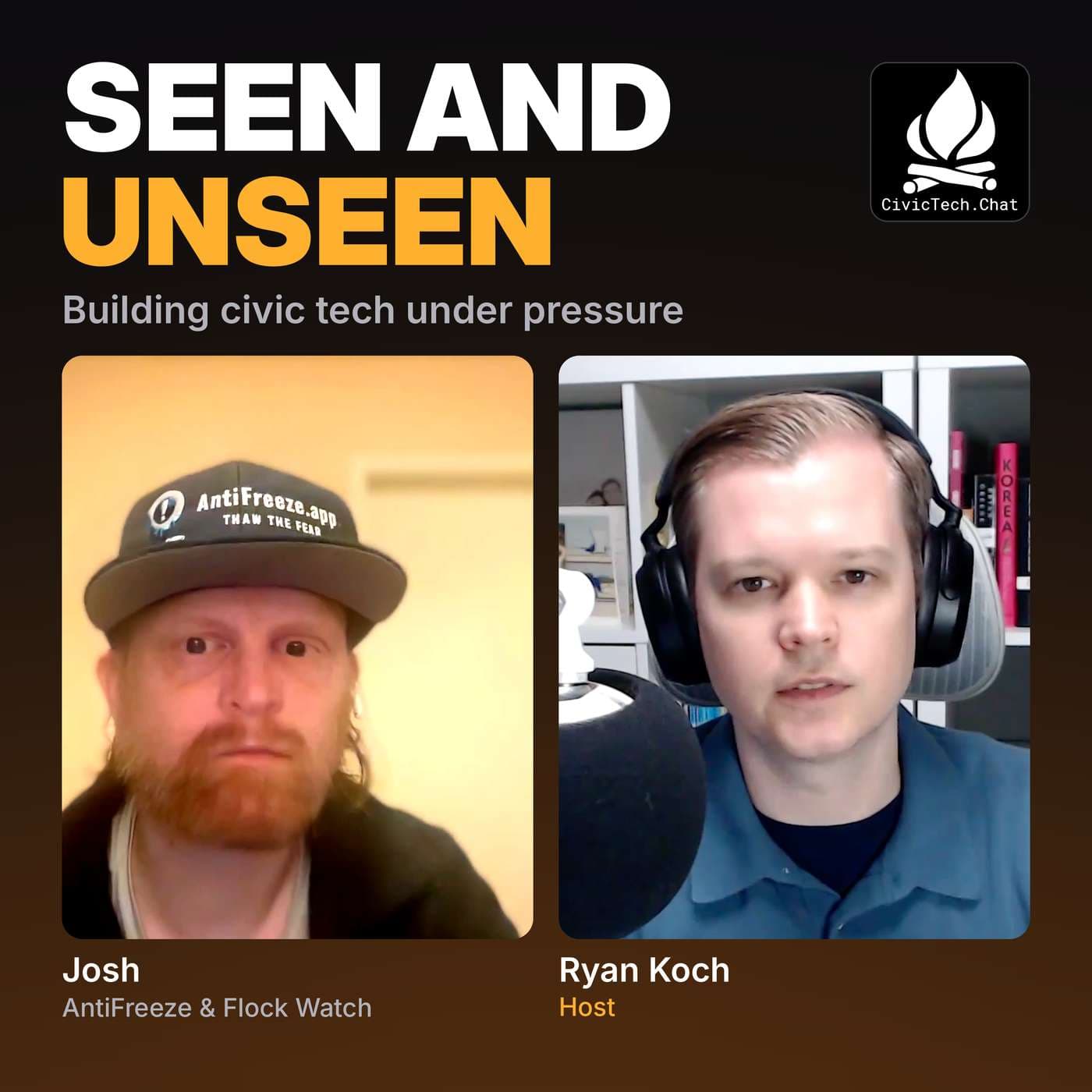
Ryan Koch speaks with Josh, the independent developer behind Antifreeze and Flockwatch, about building civic-tech tools that help people see public law-enforcement activity. Josh explains how progressive web apps, replaceable infrastructure, restrained data collection, and clear moderation boundaries can improve resilience while protecting users and maintaining safety. Key topics Civic tech projects: Anti-Freeze and Flockwatch Technical infrastructure and resilience strategies Data privacy and m
Ice Block, which does the same thing as my app does, it was called Ice Block. It was in the, Apple App Store, and I think it was in the Google Play Store too. But, anyways, it was, pulled by Apple, and Google under the pressure from the administration. And I believed in what it was doing, but I also saw that there was a single point of failure. It depended on app stores. Let's, take your headspace back to Mhmm. October 2025. This kind of getting at what you were just talking there about apps being pulled. But Apple had pulled Ice Block, as you mentioned, based on a justice department demand. And Google also pulled similar apps... Applications. What was your headspace then, and what did you decide to do as you learned about that? It just kinda disappointed me because, you know, they had reportedly a mill... You know, millions of users, you know, using their app. And, you know, any... You know, people now lost access to that because it was... You know, because it got pulled from the app stores. And I don't know. As an engineer, you know, as someone who likes to build things, the first thing that popped in my head was, you know, I would love to do the same thing. You know what I mean? Like, I would I would love to... You know, I I I... It's it's finding about finding solutions. That's what I meant to say. So,
That's what I meant to say. So, I was just thinking, oh, man. You know, what if I made it a web app and, you know, put it on a website, people can install it, or, you know, at... You know, because with... When it comes to, you know, it's called PWAs, progressive web apps. And so it it... It's like a... It's pretty much a web page, but it acts as an app, you know, where you can get push alerts and whatnot. And I decided, you know, that I just wanted to go with it. Like, I just, wanted to build it out and see if I can get users on it, and I wanted to make it as censorship resistant as possible. You know? And I kinda thought ahead. I, got a server outside of The US jurisdiction. And... Yeah. And so I just registered antifreeze.app and just started putting it out there. The two projects as listeners are probably realizing that we're gonna talk about today are antifreeze and flock watch, both both of which you've mentioned and given a little bit of description on. Mhmm. Can you talk a bit more about what those are and why you started them specifically? Antifreeze is the main project. You pretty much would go to antifreeze.app, on your mobile phone. You would hit the install button. And if you're on Android, you would actually get the native, prompt from your browser saying, you know, would would you like to add this to your home screen? You hit add or install.
prompt from your browser saying, you know, would would you like to add this to your home screen? You hit add or install. Now you have, you know, an icon in your app drawer. And so pretty much what would happen is, you can report sightings near you. And if there is a sighting within a five mile radius of your location, you will get an alert on your phone. I also have partnerships, with other similar websites. There is, you know, stopice.net and defroster is another one. It's smaller. But, and, yeah, we pretty much... Instead of being competitors, we're, you know, partners, and we share siding data. So, anyways, so, yeah, people get, you know, alerts on their phones whenever someone does report a sighting. And, you can also go into the app, and you can see a, all the list... You know, all the listings there. You can either... They'll show you all the listings within a 25, mile radius within the last forty eight hours as well as you can hit, you know, view all sightings, and then it'll show you, you know, everything. And it would, be sorted from, you know, the newest sighting, you know, to the latest sighting within the last forty eight hours. Now, FlockWatch was something, that I actually just recently built. And it kinda just shows you a map of all the flock cameras. And I was reluctant to build this because there's a similar site called, deflok. And, but one thing I thought was cool is that deflok,
but one thing I thought was cool is that deflok, actually, by default, shares, their, shares their sightings. And so, they use a protocol called open street map. So I just have it kind of, you know, pulling from the OpenStreetMap. I also have it to where if someone does see a camera, they can actually anonymously report it through, you know, through everything. You can upload a photo, put the location that you saw it at, and then submit it, and then it goes into my little admin panel. And then if it looks like, you know, it's a legit sighting, then I approve it. And what's cool is soon as I approve it, it immediately goes on to Flockwatch, but then it also goes into OpenStreetMap. So, that means anybody using d Flock will also, you know, eventually see, it on the d Flock map as well. There's also a... On the flock watch, there's also a, thing that kinda shows you, like, what agencies near you has access to the flock cameras in your area. And then there's another page on there, where you... Where there's immigration searches. So, and this uses, you know, audit logs that have been, you know, requested through, I think it's called Fios, whatever the thing is where it's the transparency request. And, so, yeah, all the immigration searches I have pulled from, eyesonflock.com. And so eyesonflock.com lets you kinda pull the audit logs and, you know, see what they, from the audit logs have searched. So, you know, whether they search for immigration
from the audit logs have searched. So, you know, whether they search for immigration or, you know, ICE or HSI, it would... It shows in that, you know, audit log. Let's talk infrastructure a little bit. Thinking about antifreeze for a moment, let's walk through what happens from when a signing gets submitted to someone actually getting a notification as you described. What's that through line, and what infrastructure gets touched along it? The person who's reporting the sighting, they, you know, enter the location or they can hit use my location. They can put in the notes, of what they saw if they want to, and then they can also optionally upload up to five photos. And then, so then, you know, they submit the report, then it goes to, the CloudFlare edge. So the the CloudFlare edge is pretty much just a little thing that sits in between, you know, the domain and my infrastructure, and that's just for DDoS protection. So then once it goes to my server, you know, it checks to see if you're banned. It checks to see if you're within that, three siding a day, rolling window. And then, if, you know, everything checks out, then it, then it goes to the photo... Then, you know, if you're uploading photos, it goes to the photo storage. But first, my app strips out all the EXIF data and, yeah, all that good stuff. So all the excess data is, you know, stripped out. It's re encoded and then uploaded. And then
you know, stripped out. It's re encoded and then uploaded. And then and then, you know, then it goes to, you know, then it goes into, antifreeze. And then while while it goes in the antifreeze, network, then, then, yeah, then it... If they have... Assuming they have, share with partner network still toggled on, it goes to all, goes to the, you know, stop ice and defroster. No reporter ID. It just sends the, you know, it just sends over the, you know, location of the siding, the notes of the siding. And then, yeah, and then, basically, my server then matches everybody within the five mile radius of that, siding and then sends out the alerts. And, you know, the... This alerts go out through, you know, Apple's push, you know, service or Google's push service. Well... And the kinda system stuff in your server infrastructure, if you feel comfortable talking about it, is that, you know, kinda your own kinda container setup that you have defined kinda somewhere with, like, a database service? Like, what's the, what's kind of the structure of that for the technically curious folks? Yeah. So like I said, so, mainly the infrastructure... Like, most of the infrastructure lives on, my, offshore, Linux server. So the only really third party, thing that we rely on is, like I said, CloudFlare, for the DDoS protection as well as that's where the photos get uploaded to. I didn't really want photos to be uploaded on my infrastructure because I... There's been vulnerabilities where people have
for the DDoS protection as well as that's where the photos get uploaded to. I didn't really want photos to be uploaded on my infrastructure because I... There's been vulnerabilities where people have figured out how to upload, you know, on any kind of, like, uploader type scripts, find vulnerabilities, and upload something malicious. So it's all... In my opinion, it's always best to go through, like, a third party like, Amazon s two. But I went through, Cloudflare r two, which is kind of like the Cloudflare's s three protocol, kinda like Amazon s... AWS. And luckily, it's not completely gatekeeped Because if for whatever reason, CloudFlare decides to shut me down, I can always find another, s three. But, yeah, all the data and everything, are mine. It goes on to a Postgres server on the server that that I rent offshore. You started to get into this a bit. So, you talked about using progressive web app tech to sidestep app stores. You mentioned trying to kinda have your storage be something that you can change if you need to, whether it's, like, the r two service you're using now or something else in the in the future. You do rely on some push services from, you know, the Apple, Google, and Mozilla as the Cloudflares of the world. Mhmm. Use cloud for for photo storage, and Flockwatch uses OpenStreetMap. So Right. From your perspective, what does it mean for apps like the one you're working on to be resilient to gatekeeping
So Right. From your perspective, what does it mean for apps like the one you're working on to be resilient to gatekeeping as you kinda have as your goal? Yeah. So, yeah, that's what I wanna kinda go, on about. So... Yeah. So... Yeah. And and an App Store is kind of a choke point. A per... A push service is just a pipe. So Apple pulled ice block, with one decision. Antifreeze is a website, so there's no listing to pull. And then updates, you know, so anytime I do an update, it automatically, goes to your phone. The next time you open it, you should see the latest version. Because like I said, it's just pretty much a website. It just behaves kind of like an app. So push is the the real, the only really real dependency on Apple and Google, but it's also the hardest to aim. It's a web standard, and the messages are encrypted end to end. So, blocking it would pretty much be be singling out one site, which, from what I've read, Apple and Google rarely, you know, ban ban push in points because it's just it's just kinda hard to. And and what they will... They... What they might do is they have banned if there's been, like, abuse, like spam and whatnot. But... Yeah. And even then, like I said, it would it would require them to single out one site. But even then with it, like, being end to end encrypted, it it would just be kind of,
like I said, it would it would require them to single out one site. But even then with it, like, being end to end encrypted, it it would just be kind of, but... Yeah. But even if push were cut, by god forbid, which I don't really see it happening, the map refreshes every time... Every minute while it's open. So you would just lose the buzz in your pocket, but not the information. Yeah. Since we're talking about kinda, like, possible failure modes, choke points, that sort of thing Mhmm. We we can do, like, a little bit of chaos monkey thinking, which is kind of that old, like Netflix kind of style of thinking about, like, how you manage risk with your infrastructure. Like, if I go into your data center and I start yanking cables, will the app go down Mhmm. Actively? So if someone were to try to gatekeep either of these apps, in your view, where are you expecting them to go first? So one of the strike points is the domain registrar. So somebody... You know, the administration could, pressure Anjala or whoever to, you know... Or even... It's antifreeze.app. And so it's a TLD by Google. So they can either pressure pressure in Jala or Google to take down the .app domain. So then antifreeze.app stops resolving. But, luckily, I do have a backup domain. It's antifreeze.is. It is the Iceland TLD, and, .is or Iceland has been, very known and and, to, you know, be,
very known and and, to, you know, be, proponents of free speech. So I would just, just send a push notification to everybody because of what... Even even if the app that goes down, I I can still send push notifications. I still have my data of all the push in points. So I would send a push notification saying, hey, everyone. Antifreeze.app.got pulled. Go to antifreeze.is and just remove the old antifreeze app and reinstall it on antifreeze.is. So if the, another strike point would be the hosting provider drops me. And so if that happens, everything does break until I move it. Luckily, I do keep backups. So all I would have to do is take my backups with the database and move it over to a new host. Another strike point would be, CloudFlare drops the account, and that would, you know, hurt our attack protection as well as photo storage. So, so the photos use s three, so that can just move to another s three endpoint or even, you know, maybe even, like, a local, upload script. But, you know, I'll just have to, you know, change how I do photos, citing photos. And, the site would just run without CloudFlare, so I'd have to find, you know, another way to protect myself from DDoS. Another strike point would be Apple or Google block push. But like I said, all that would break was, you know, alerts will stop buzzing on phones. But, the app still works and refreshes every sixty seconds so people can still manually go in and, you know, check the app.
the app still works and refreshes every sixty seconds so people can still manually go in and, you know, check the app. So another checkpoint would be open street map or the deflok goes down. And what would break with that would be Flockwatch stops updating... You know, Flockwatch stops updating cameras. But, the last good copy stays in the database. So I also have, you know, all the, you know, the deflok tiles, they're still up. But, yeah, another strike point would be a flood of fake sightings, which would cause, you know, a no... A lot of noise and false alarms. But like I said, what I've done to prevent that is, you know, three reports. You know, if if you're a regular user, you can only do three reports a day, within a twenty four hour window. And so all I'd have to do is just ban that device, and delete the sightings. But, yeah, I would say probably the main strike point would be, like, legal pressure on me, and what would break would just depend on the demand. And, you know, with citing data, the... Who reported it device ID is scrubbed after seventy two hours of the sighting, and there's no accounts, no names. So even if I do have legal pressure and I am subpoenaed, there's just not really a whole lot to hand out in the first place. You know? Even if I do hand over every source of data that I have, there's just nothing really of value to hand over.
source of data that I have, there's just nothing really of value to hand over. Have you, have you run into any situations where you had to respond to folks trying to either act on one of those strikes you're worried about or, like, work around a mitigation? Like, for example, you know, you limit to three reports per day. You have the ability to ban. Have you kinda hit something where someone was trying to work around that, and if we had to, like, execute a bunch of bans or or with one of the other risks, a similar sort of incident? That's actually kind of inter... That's actually an interesting question. So, you you know, what's been interesting about it is that, so far, even after, roughly over 12,000 installs, it seems like everybody has been playing nice. I only have maybe two or three devices that I've had to ban out of the 12... Out out of the 12, 13,000 installs. One thing that I did notice is that, someone did figure out a way to, submit a siding without having to go through the, you know, is this a real device? Is this a real fingerprint? And they were able to, like, kinda register a dummy account, with just hitting the API directly. They found a vulnerability, basically. They didn't do anything with that vulnerability. I think they were just kinda poking around for fun. But either way, I was keeping an eye on it, and,
They didn't do anything with that vulnerability. I think they were just kinda poking around for fun. But either way, I was keeping an eye on it, and, I immediately patched that vulnerability after I noticed it. So... Yeah. If you're comfortable answering, how did you wind up noticing that? It it... It's... I I find it particularly interesting when you when you kind of end up in a situation where you get to discover vulnerability, whether it's through penetration testing or in this case, some accidental free penetration testing, and then have the chance to respond. So, like, what what was that like in practice for you on this one? Yeah. So, actually, I was actually... It was kind of on accident. So I was looking at the database. Right? And whenever a user installs the app, it goes into a user's table, and that consists of their, you know, a random user ID. Right? It's nothing to really do with the device. It's just a random, UUID for user ID. Right? And then their device fingerprint, their last, location, and then their settings, like, you know, if they have something on or off. But, anyways, one thing I noticed is there was a new user in there, with a new user ID, and their device ID was, like, 000 or, you know, something definitely fake. It wasn't a real device fingerprint. And I was like, So I went in and, you know, I was trying to figure out how they did that, and then I realized, okay. This is how somebody could actually, you know, bypass,
you know, I was trying to figure out how they did that, and then I realized, okay. This is how somebody could actually, you know, bypass, you know, bypass the actual device fingerprint. So, yeah, now I have it set up to where, yeah, it has to be a real minted thing... Fingerprint, in order to, you know, in order to actually get your device on the network. So... Yeah. So, yeah, I... I've I've definitely, you know, taken security seriously, not only to, protect the people that have it installed, but also, you know, protect, you know, the the the data integrity. You know? Make sure that nobody's out. You know? Or try to mitigate as much as possible any fake sightings or, you know, people trying to just abuse the system. Now, of course, there's... You know? And and by fake sightings, I mean, intentionally fake. Of course, we get a lot of sightings where, you know, somebody might have thought that something was ice and it wasn't. And and like I said, it is just an open, you know, thing where people can go on there and, you know, report. So, you know, it... Just because it is kind of an open network of event reporting, you know, it's also kind of, you know, expected for everybody cannot use their own, you know, due diligence. And, you know, I always recommend people upload photos of what they saw and try to be, you know, as detailed as possible.
you know, I always recommend people upload photos of what they saw and try to be, you know, as detailed as possible. I, I think we've given listeners out there that are into advocating for observability a great anecdote to support support their case from your story. And, actually, you mentioned, fingerprints IDs there again, which I think is, like, a is a great segue into kind of some of the data privacy conversation stuff for for this, for this episode. And, but before we started, we talked a bit about, your use of fingerprints and kind of the data that goes into forming those. What should listeners take away about the kind of data that's collected and used for kinda antifreeze in in in these projects? You gotta have an email or password or sign in with Google or, you know, enter your phone number and you confirm a, you know, text to your phone or whatever. So, yeah, with mine, there's no accounts, no email, no phone number. But what we do have is I like to call, pseudonym... Pseudo anonymous, not anonymous. And what happens is when you, you know, install it on your phone, what's minted is like this little short device, ID or a browser fingerprint, which is used to block abuse. Now that fingerprint is just, you know, dedicated to antifreeze. So there's no way to, for example, use that device fingerprint to, you know, see what other sites that you signed up for. It's just before, you know, identifying you on antifreeze, but there's no way to tie it back to anything identifiable.
use that device fingerprint to, you know, see what other sites that you signed up for. It's just before, you know, identifying you on antifreeze, but there's no way to tie it back to anything identifiable. So, yeah, the IP address is never stored. So there are, the only time... The closest thing to, like, I guess, IP address storage would be... I would say there's about less than 1% of users. For whatever reason, the device can't meant a fingerprint. And I still wanna prevent abuse, but what we do store is a salted hash of an IP instead. But it's still not your IP address. I still can't figure out what your IP address is. It's just a salted hash, so we can still have... Even if for whatever reason the device is not minting a fingerprint, we can still have something, you know, in there to kind of, you know, prevent abuse. But the takeaway for listeners is, you know, everything stored is tied to a device, but none of it is tied to a name. Whenever you submit a sighting, that sighting does have your device fingerprint on it for up to to 72. After those seventy two hours... And it is just for, you know, abuse prevention. But after those seventy two hours, that device ID is scrubbed, and then it just becomes archived. You know? So no... So I don't I don't even... After seventy two hours, I have no clue what device, submitted that. Right? So,
submitted that. Right? So, so the device ID on that siding is now replaced, with just archive. So, anybody who gets access to, old sightings, it points to a, you know, street address, not a person. So a subpoena for the archive gets, you know, addresses and description, but not who reported it. And you mentioned, after seventy two hours, that's when it goes kinda archive and it's a backup as effectively what exists. What kind of retention of policy do you apply to those backups, and what's, like, the access control look like for that? So, yeah, I do have a backup and... Or, you know, I do have an auto backup. I make sure it gets backed... Everything gets backed up once a day, but I do not keep, backups older than seventy two hours. So any any... Or three days at... You know? So I always keep, like, a rolling three day backup. So, you know, the latest being, you know, today, and then I also have a backup from yesterday and then the day before. And the reason why I do it that way is just in case for whatever reason there was... You know, I have to restore backup and for some whatever reason, like, the latest backup was corrupted or whatever, I always have, you know, at least, three backups to work from. But, yeah, just out of, you know, keeping everything private, I don't wanna keep an indefinite number of backups, and there's just no reason to. And and, you know, not only for... Is it for, you know, user privacy, but it's also, you know, I mean, if I just keep all the backups out of my storage, we get full. So, yeah,
number of backups, and there's just no reason to. And and, you know, not only for... Is it for, you know, user privacy, but it's also, you know, I mean, if I just keep all the backups out of my storage, we get full. So, yeah, that's pretty much it. But, yeah, if if for whatever reason a subpoena landed within that seventy two hour window or reached a backup, a device linked to that, specific siding would still exist. But, you know, they won't be able to see, you know, likely all the sightings that that device submitted. So, you know, the the whole reason why I do archive it is just so where if they do get a subpoena, they won't be able to see, okay. Well, this device has, you know, submitted sightings here, here, here, and here. Right? They'll just be able to see the sightings that that they submitted within the last seventy two hours, which is usually just, like, maybe one or two sightings at the most. They won't know who... You know, what sightings before that. So 72 they submitted, basically. The fingerprint IDs that you're building, are those a a one way function where, hey. Like, all the bits of data that come together to form it, like, I can't figure out what those were after. I've... You know, from just the fingerprint ID itself. Right. Yeah. So I actually... I'll let you know. I actually use... It's an open source, tool called... It's called, Thumbmark
tool called... It's called, Thumbmark JS. And, yeah, it's a open source, fingerprinting library. The fingerprint is minted, in the browser. So, yeah, like, it, it it it is pretty much just one way. And then what's cool about it is, I I just... I don't store the data that went into that fingerprint. Oh, okay. So kind of as the fingerprint's minted, you, like, use the data to do... To create it, but then poof, after that function is done. Thumbmark JS has a, an algorithm, that mince the fingerprint based on it, and then the fingerprint gets minted within the browser. So, yeah, it all happens on the user's device. The only thing that goes to my server is the fingerprint itself. So... Which is, like I said, pseudo anonymous. Okay. That's a a useful, distinction. So effectively, that device information, you never physically have it to even be able to store it is what I'm hearing. Correct. Yeah. I I I I don't. There there is a, if you look into some mark JS, there is an option where you could, collect that, but I I, you know, I I, I, you know, I have it intentionally where I, you know, that information does not go upstream to the server. And if a user wants to, they can, you know, audit the app to see what does go to the server. And that's what's lovely about, PWAs is, you know, if someone wants to audit it and just fear... Figure out what data they wanna get, you know, if if they're, you know, if they know how to use dev tools and, go into the network and, you know, see it, you know, they can go in and look. Whereas
is, you know, if someone wants to audit it and just fear... Figure out what data they wanna get, you know, if if they're, you know, if they know how to use dev tools and, go into the network and, you know, see it, you know, they can go in and look. Whereas whereas, you know, native apps from the App Store or whatever, you have to figure out how to compile it and all that stuff. Whereas, what's cool about a PWA is it's way easier to audit. And I think we've talked about that, sightings remain for for longer. I believe, roughly... Or I think indefinitely, if I remember from our prior conversation. Who has access to that archive of sightings and kind of... What ends up being your plan if that subpoena does one day come to your mailbox? The public fetal, they only see sightings for up to four... You know, in the past forty eight hours and newer. Right? But, I do have what's called a watchdog, platform, and that's, you know, vetted users often, you know, local IceWatch groups, such as, IceWatch SoCal was one of them, Music City, MiGrawatch, you know, as one of them. And, yeah, they can go in and they can actually, if they want to, you know, look at all the sightings if they want. And like I said, if, you know, if a subpoena does come, like I said, if they do get access to my database, all they would get is kind of a, a list
like I said, if they do get access to my database, all they would get is kind of a, a list of sightings that have been submitted. They pretty much would just get everything that the watchdog would have access to, which is really nothing, identifiable. So, you know, they would get, of course, get the access of users lists. So what's cool about the users list? I guess the only thing, I guess, would be identifying is we so we don't keep a location history. What happens is when you open up the app, we do get your, the last, latest location, and it's it's rolling. So whatever last you open up the app at, we do... You know, I mean, that does go to our server so we know who to submit the sightings to. But then the set... The second you open up your app in another location, then we lose that location and it gets updated. So, yeah, it's just your last known location. But, for the people that are extremely cautious, you can turn off use my current location. And instead, what you can do is you can just set a location manually, and that can be like... You can set it's like an intersection nearby you. You can... You know, whatever. And then instead of getting, you know, sighting alerts based on your, actual location, you would just get sighting alerts based on whatever location you put in manually. So there's, you know, I would say there's a good, you know, I think, 10% of people
So there's, you know, I would say there's a good, you know, I think, 10% of people who like to opt out of current location to just use the manual, you know, the manual location to get their sightings from. Okay. So I think it sounds like that attack surface for, like, a risk surface is a better way to put it, for a person would be kind of whatever the most recent location was at the point of a backup. So then there... I guess there could be up to three in your in your set of data that someone could subpoena. Three locations. And then... But no more is what I'm hearing it. Because I believe you said it was daily. Right? Because I... And you're overriding constantly. Yeah. It's... I'm overriding. Yeah. After the third day, any backups older than three days get automatically purged. So it's, you know, one, two, three days, and then the older ones get purged per... You know, constantly. So... Yeah. You've also said that the, Electronic Frontier Foundation has reviewed antifreeze, specifically. What did that entail, and what were the findings that that came out of that? I reached out to EFF, and they reached back out to me. I went on a a a phone call, and they pretty much just kind of advised me on what I could do to mitigate, you know, to make it as legal as possible. Right? So, they recommended me... You know, before the EFF review, I didn't have,
the EFF review, I didn't have, the disclaimer on the report page. And then now whenever you go to report a sighting, it actually says community guy... There's actually community guidelines now to report, if you can see that. But, yeah, basically, it entails, you know, do not do not harass or threaten anyone. Do not post, you know, personal information about the officers, and do not attempt to obstruct law enforcement. And any violating post will be removed and could result in a ban. So, yeah, if, luckily, no one has done that so far, but if anybody did, you know, post the siding on there and says, let's go get them. Let's go, you know, tip an ice car or something like that. I would, you know, I would, of course, remove that siding and possibly even ban that user because, you know, we're not we're not trying to start chaos here. We're just trying to keep people informed. That that does make a lot of sense. And I think that's a good segue into kinda, like, safety and and and data stuff. Mhmm. You're probably aware the the justice department and the Department of Homeland Security have an opinion about apps like these, and they say that showing real time agent locations puts those agents at risk. And that was the thing Apple cited about their argument when they pulled Ice Block, as we mentioned at at the very be... Very beginning. What's your response to that concern, and did it shape any of your design decisions?
to that concern, and did it shape any of your design decisions? Well, yeah, I know the administration does say that puts agent at risk. But, you know, the thing is is reports, in my opinion, reports about law enforcement activity in public places, these are things anybody on the street can see... Can already see. And it works just like a neighborhood hood alert, and it's not like a tracker on a person. You know? No one's putting, I don't know, air tags on ICE agents' vehicles and that... And then that's getting tracked in real time through the app. I mean, it's just their activity, you know, being tracked. I also have it to where, you know, there are, you know, design limit reach. So, yeah, alerts only go out to people within about five miles, and, you know, the sightings do drop off the map after forty eight hours. But the the aim is to let families prepare and know their rights, not to interfere. And, you know, I even say in there, you know, don't interfere with law enforcement. And I do understand that I don't have control over what people do with the data. But as I said before, you know, these are reports about law enforcement activity in public pace... Places. Waze, you know, offers, you know, police sightings, you know, police up ahead. It's kind of, you know, first amendment. But, yeah, the... You know, you can't post officer names. You can't post an officer's home address. That's all
post officer names. You can't post an officer's home address. That's all banned. Activity going on in public, you know, is, in my opinion, you know, people have the right to know that. What scenario... If if there even is one that that you've imagined would push you to either, like, pause the app service or or take it down if kind of things got to a place where they were, like, kinda beyond your ability to control it? The only way I'd really would take the app down myself, and there have been lines that I have drawn, if there's just been an in... If there's, like, an influx of the app being used to target individuals and just a bunch of people trying to do docs ICE agents, with their home addresses or phone numbers and trying to harass, and and it's done at such a rate that it's just hard for me to moderate. I can see myself, you know, taking it down Because like I said, I'm not trying to start chaos. I'm not trying to get anybody hurt. You know? I just wanted, you know, information to be public of public activity. If for whatever reason I'm not able to protect users' data, so if there's, like, a big compromise or something and somehow something's done where their data, you know, is compromised in a significant way, I'd probably pull it off. Or, if for whatever reason, if a bunch of of a bunch of communities and a bunch of big areas start, you know, messaging me and telling me that,
if a bunch of of a bunch of communities and a bunch of big areas start, you know, messaging me and telling me that, it's doing more harm than good, then, you know, I might pull it down then. I'm curious. I guess maybe twofold. One, has an agency kind of reached out, like, with the Wish, like, dispute, assigning our record, like, on Flock Watch? If that has or hasn't happened, like, what sort of process do you have in mind if that's something on the government and that they decide they wanna reach out to you about? Well, yeah, if anybody wants to dispute a siding, whether it be a flock camera siding or a nice siding or whatever, You know, the the the contact and support of antifreeze is out there. You know, they can reach out to contact antifreeze.app support and antifreeze.app. There's, you know, a signal number that we have on our support page. There's, you know, many ways of reaching out. But, you know, primarily, I would just say just email us, and, you know, we'll kinda show you where the public record of the entry, like, came from. And if the record is wrong, we'll mark the entry as, you know, disputed or even, you know, maybe deleted if it's completely false, but, you know, I I... I'm not the type to just, you know, delete a public record. So I'd like to talk a little on sustainability, as as our conversation goes. You're also doing
as as our conversation goes. You're also doing quite a lot with this being a solo operation. You've got now kind of a main product, and it... A product next to it, a day job. And, you know, you're keeping the infrastructure funded, you know, kind of all the things that go to keeping a system up and serving real folks. What happens if one day you wake up and you're starting to get burnt out or kind of the donations that help you fund it slow down? Mhmm. Yeah. I thought about that. And what is real is, you know, I am just one person with a day job, you know, paying for servers out of pocket and through donations. A fiscal sponsor is in progress, but not done. I'm still trying to look into that. But I would say what already lowers the risk is sightings, you know, are shared, with stop ice and defroster and vice versa. So alerts keep flowing, you know, even if I don't have the time to upkeep it. You know, backups are off-site, and, you know, project Galileo covers the, cloud, you know, and edge costs. But what would help the most is a second maintainer, like, finished fiscal prompt... Sponsor... A finished fiscal sponsorship and reoccurring small donations. It... Like, all these small donations, all the, you know, support contact that I have, it it does give me a meaning to keep go... You know, it does give me meaning to keep going and keep pushing. Next, I wanna talk about kinda lessons folks can take from our conversation, also the work you've been doing. Right? So something we've been talking about, though, I don't think we can necessarily use this phrase. It's actually like alternative
it it does give me a meaning to keep go... You know, it does give me meaning to keep going and keep pushing. Next, I wanna talk about kinda lessons folks can take from our conversation, also the work you've been doing. Right? So something we've been talking about, though, I don't think we can necessarily use this phrase. It's actually like alternative infrastructure. Mhmm. What does that mean in practice for kind of small organizations and nonprofits that are kinda doing work in their mission spaces? And what's the first step they could take? Yeah. So I would say, to me, it means owning the parts that would hurt most to lose. You know? So, like, owning your domain, your contact list, and your way of reaching people. Rent everything else in a way you can replace. So... Yeah. List... You know? So I would say the first step or the first lesson of alternative infrastructure would be to list every company that could switch you off, including your App Store host, domain registrar, email provider, payment processor, social account, and then pick the riskiest one and, plan a replacement for it, you know, this month. You know, free tools worth naming, you know, CloudFlare, Project Galileo. They pretty much will support, at risk nonprofits, PWAs, and web push in place of app stores and signal... Use, like, signal or whatever for a sensitive support conversation or use, you know, ProtonMail for sensitive, support conversations. If a listener out there has been inspired
If a listener out there has been inspired by our conversation and they wanna build their own tool, maybe in some other, you know, space where there are sensitive concerns like the ones we've talked about today, what would you wanna tell them? So, yeah, here's, you know, just some advice I would give. I would say collect less data than you think you need. You know, data you never, you know, stored can't be subpoenaed, so try to keep the data you collect as low as possible. Also, make your privacy claims as precise as your code. So, you know what I mean? Like, when you write your privacy policy, make sure to kinda, like, look into your code, make sure that's, you know, accurate. And I learned this firsthand. The gap between the marketing line and the policy is the first thing a careful reader will find and scrutinize. Step three would be to talk to lawyers before you launch. You know, maybe reach out to the EFF, a law school clinic, or the NLG, not not days after the letter shows up. So, you know, be prepared in that arena. Build, with organizations already doing the work. You know? Share the data with them and, you know, don't reinvent what exists. You know, d Flock is a good example. And then, you know, also, the big one is plan for your own absence from day one. So, you know, whether it be a dead man switch or whatnot, just... Yeah.
And then, you know, also, the big one is plan for your own absence from day one. So, you know, whether it be a dead man switch or whatnot, just... Yeah. And as our conversation comes to its close, for the listeners out there that are curious and wanna follow your work, where should they go and do that? Yeah. So, my kind of portfolio... Everything is... You can go to wafflehacker, .dev, waffle,waffle, and then hacker,hacker,.dev. No spaces or dashes or anything. And there you would see, you know, list of all my projects. There you can find... You know, go to writing. So, you know, my writing, I write mainly on substack@wafflehacker.substack.com. Another, place where I write, though, is at the Daly Coast, which is Daly Coast. That's daily, kos.com, /user/joshhacks, joshhacks. Those... But those are the primary places you can reach out to me. Good night. Worry it out, folks. I'll also make sure those things are in the show notes so that if you just want a clickable thing, you'll have it on your app or on YouTube or wherever it is you happen to be hearing me through the fourth wall right now. Cool. And, Josh, thank you so much for joining us here on Civic Tech. Me. Of course. Yeah. Yeah. This was a really fun conversation, and I think folks will get some really interesting stuff to learn out of your, Roche alternative infrastructure. Absolutely. Yeah. Thanks... Like I said, thanks for having me.
Yeah. Thanks... Like I said, thanks for having me. Visit us on the web at civictech.chat, or subscribe to us for content updates wherever it is you download your podcasts.