
Welcome to another episode of the Democracy Innovator podcast, and our guest of today is Alpha... Alfan Linge. So thank you for your time and for being here. And, I have, I mean, the first question is, if you can say something about you, your experience, your background. So Yeah. No. Thanks thanks, thanks, Alessandro, and thanks for inviting me to to to speak on on your podcast, and I'm looking forward to this conversation. Yeah. So my name is Helf Dan Lungen. You were close enough. It's a it's a Danish name. I am from Denmark. It's a little bit hard for for non Danes to pronounce, so, so you were close enough. I'm currently a chief adviser in the Danish Agency for Digital Government, which is the government agency in Denmark that runs most of the, digital, public infrastructure, identity systems, payment services, etcetera, etcetera. I work specifically on data governance and sort of open data infrastructure. We run-in open data platform, the Danish... The national date... Danish national open data platform, called Data by Visa, which is a metadata catalog for for government data from across government. I think it's about 300... Oh, no. Three and a half thousand datasets now, from, more than around 100 agencies from across government. So that's my daytime job. In addition to that, I'm I'm a visiting senior researcher at, Wits University in South Africa, where I'm also a research filler... Fellow at something called the, Tyresha Center for Digital Governance,
Democracy Innovators
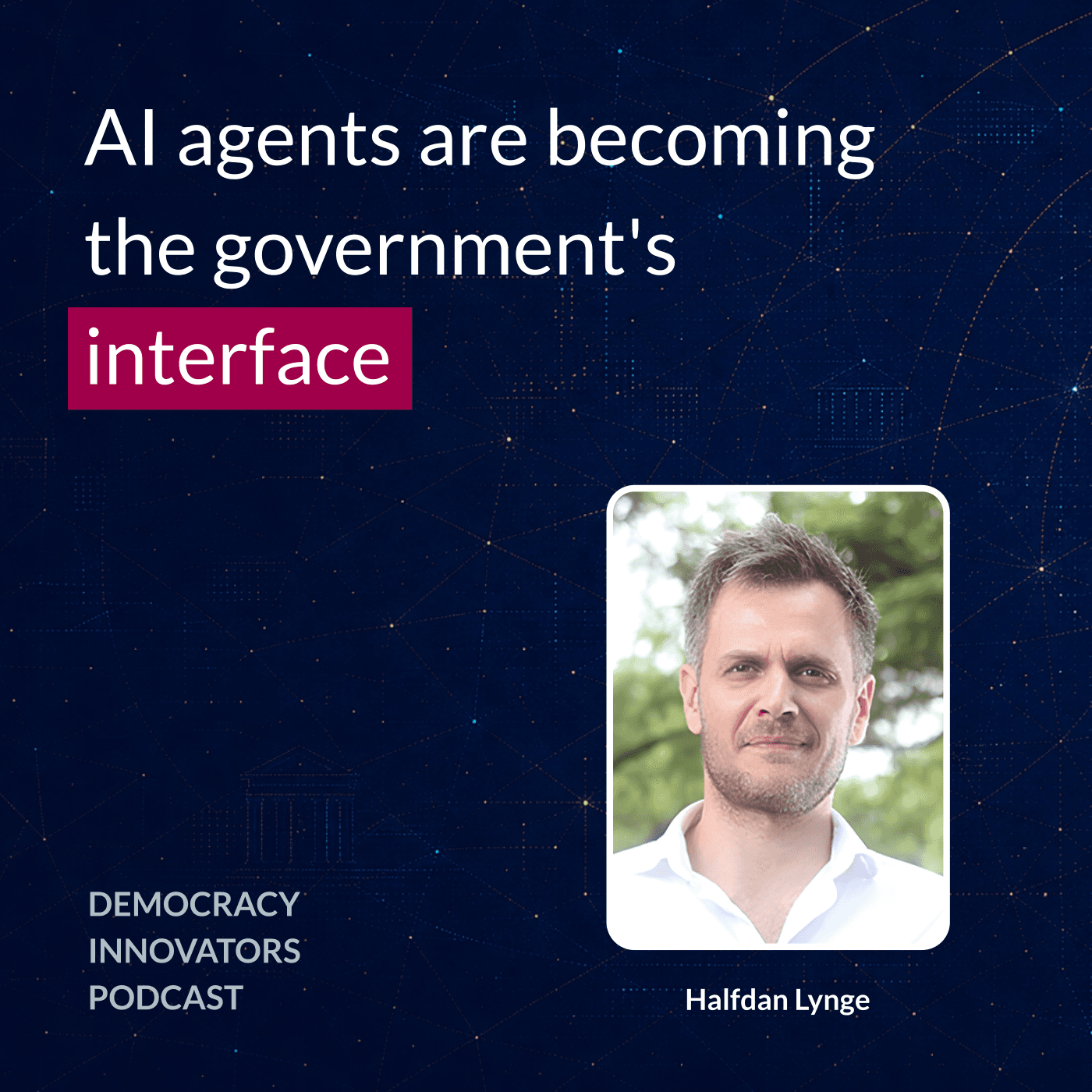
Halfdan Lynge on state-citizen relations when agents become the front end of government
Halfdan Lynge draws on his work in Danish digital government and his experience in Mozambique to discuss where civic tech and GovTech overlap, and how infrastructure, funding and regulation shape what can be built. He and Alessandro then consider what happens when AI agents become an interface between citizens and government. The conversation ends with a question for democracy itself: how might its institutions change as technology changes the way people participate? If you enjoy our podcast, pl
Digital Governance, which is hosted at, at Wits University. The reason I'm attached to a university in South Africa is that I was previously, an faculty member staff at the Wits University. I was a senior lecturer there, taught political economy and quantitative methods, and and and was part of a small team that contributed to setting up this, the center, the Tyresha Center on Digital Governance. Prior to that, I mean, I've worked in this space for more than twenty years now. I started my career as a a UN official. I was working with UNDP, United Nations Development Program in... First in in... Shortly in Ethiopia, then Mozambique, and and lastly in in Bangladesh where I was... These were the very sort of early phases of of what we today call digital government. At the time, it was called... I think we called it e e government at the time. So these were very sort of early stage initiatives on how to introduce technology in in public administration. In Mozambique, I was I was, involved. We were working with the electoral commission of, of Mozambique assisting, the the technical secretariat with setting up biometric voter registration and verification and and introducing sort of digital systems for the transfer of of results. But this is, you know, these are standard things today, but twenty years ago, it was it was it was fairly new. In Bangladesh, I worked in what was called the resident coordinator's office. So that's the part of the UN that's responsible for coordinating,
in what was called the resident coordinator's office. So that's the part of the UN that's responsible for coordinating, activities from across the different UN agencies. And, specifically, I was involved in the initiative that eventually led to Bangladesh's first digitalization strategy called Digital Bangladesh. Again, these were... This this is twenty years ago, and and and these were fairly sort of new things at the time, but but but nowadays, they're they're common practice. After about six years, I think I left I left the UN, and and went back to university, to pursue a a PhD. I was a PhD researcher at Oxford University and did that for about, well, too long. These things often take longer than they are meant to. I think I was on and off in Oxford for about six years. And in the meantime, I I actually returned to Mozambique and set up a a a GovTech startup, working on... Essentially, what we we did was to build up a a platform, that allowed us to crowdsource information, through, mobile phones. And it was a fairly simple technology based on on sort of third generation mobile technology, so SMS and USST. And we set up this platform that allowed us to send bulk SMS out and collect, you know, little questionnaires. And and it was a way of of collecting information from citizens, and we used it for anything from political polling to market research. But but the real sort of interest in application, I think, was for crowdsourcing and and and and creating a platform that allowed sort of citizens engagement real time in a... And I think that's important to keep in mind. Mozambique,
political polling to market research. But but the real sort of interest in application, I think, was for crowdsourcing and and and and creating a platform that allowed sort of citizens engagement real time in a... And I think that's important to keep in mind. Mozambique, at the time and to some extent still today, was a very sort of low connectivity environment. There was no there was no three, four, five g coverage across the country. So you can't use smartphones. You can't use Internet. So you have to design technological solutions that allow people to use their sort of simple feature phones, SMS, and that kind of things. So I did that for, about also six years or so before I then, joined, the university in in South Africa. So it's it's a long story, and it... And my career has taken many sort of twists and turns, but I think the the sort of, the underlying threat is an interest in in in in how technology can be deployed and specifically... I mean, I come from a kind of data science background or computational social science, and, that's always been my sort of interest in how we can use technology and specifically sort of data and and data analytics to improve, public service delivery, whether that's through fixing things in government or it's through, you know, kind of a civic tech approach where you can use these kind of tools to hold government accountable, etcetera. But but that's really the sort of the the center of of of, of my interest and and what what
etcetera. But but that's really the sort of the the center of of of, of my interest and and what what what I I suppose kind of connects all these different, different elements of of of my professional career. Yeah. So you you have worked on a lot of things. And I was wondering with some some friends that, I'll send to you here in the podcast. Sometimes we were talking about the different... About civic tech and gov tech, if it makes sense to make two categories or not. And, what do you think? Yeah. I mean, I... I've had extensive conversations with my previous colleagues and now friends at at Wits University. So at at Wits University and under the umbrella of the Tyresha Center for Digital Governance, we hosted something called, the Civic Tech Innovation Network, which is a network of researchers, activists, sort of civic techies from across, from across the African Continent. And and and, until today, I I sit on what's called the reference group. So kind of like the the the body that's... That, oversees, there's a small secretariat that manages sort of day to day activities, but I still sit on on that reference group. And and in that context, we often have this conversation, what's GovTech, what's CivicTech, and now we're talking about the same thing. In my conceptualization, CivicTech is deployment of technology with the purpose of enhancing transparency, enhancing accountability, etcetera. So it's kind of like working with the mechanics of a democratic state as a way to,
etcetera. So it's kind of like working with the mechanics of a democratic state as a way to, I suppose, force governments to deliver what they're supposed to. Right? If you increase transparency and accountability, it's a way of ensuring that government are actually, delivering what they're supposed to deliver. Now now maybe I should say GovTech for me is kind of the... I think I lean very much on the sort of OECD definition of of GovTech here. It's the collaboration between public sector and private sector, be it for profit, corporate, corporations or, civil society initiatives, but it's a couple... Collaboration between public and private with a view to improving government service delivery. Right? So improving systems, processes, etcetera, within government. But it very much centers on the sort of collaboration between government and and and nongovernmental sectors. One of the reasons I think why there's often a confusion and specifically in the context of Africa is that the whole civic tech concept for me presupposes a functioning democratic state. Like, if greater accountability, greater transparency, etcetera, if that is... If that should lead to increased or improved service delivery. It it's... It it presupposes that there is some kind of relative functioning state already, that the that the state, that the government is able to deliver something. It might not do it for x y z reasons. There can be sort of political economy questions. There can be capacity issues. But there is... Like, the core is in order. And by
It might not do it for x y z reasons. There can be sort of political economy questions. There can be capacity issues. But there is... Like, the core is in order. And by by exposing inefficiencies or by pointing to deficiencies in government service delivery, it's assumed that you can kind of like push or notch or force government to address its issues, right? Now in the context of Africa, that does not necessarily exist. Right? Even if you expose, let's say, corruption or inefficiencies in the public sector in in in in a in a... Let's let's take Mozambique, which is a country I worked in for many years. There is no guarantee that that will translate to any change, any improvement because of the incentives that are built into the system, and the sort of lack of fundamental accountability. Right? So the concept of civic tech doesn't... In my view, does not necessarily apply if if the basics are not in order. And and the implication of that is that if you look at the initiatives and the organizations and the people that are active and involved in the civic tech innovation network, which is an Africa specific network, you would often see that the applications, the deployments, the projects they get involved in is much closer to what I would consider GovTech simply because they are essentially trying to fill the vacuum or fill the, the the the, yeah, the vacuum that's missing. The the the the the the the the absent state creates a vacuum. Right? And now civil society,
The the the the the the the the absent state creates a vacuum. Right? And now civil society, private sector are trying to fill that vacuum, be it in terms of, making sure that, services reach the, the most remote areas or that citizens have basic information. So it's much closer to GovTech whereas whereas as the sort of traditional civic tech in... Initiatives, in... Initiatives. They're... They they... Even if it's called the Civic Tech Innovation Network, they're not necessarily the sort of bigger bulk of of of, of initiatives or or or or projects in the African Continent. Now that's my personal view, and I have had many conversations with my colleague and colleagues in in in, at this university and and and across the African continent, and they don't necessarily agree. But at least it's this kind of like my my thinking around it that there's a clear distinction. Oh, there's a there's there's obviously an overlap in the mid mid, but but there are fundamentally two things that... And then there are and there are solutions to different types of problems. Has a long answer to something that shouldn't necessarily be that complex, but I hope you understand what I'm saying. Yeah. Absolutely. I I think that, I mean, if people that are in this field, repeatedly talk about the the this, distinction of civic tech and of tech, maybe, is not so... I mean, it's worth it to think about it. And, I was thinking in relation to the context of Africa.
I was thinking in relation to the context of Africa. Mhmm. I can imagine that many other things were different. But, if you could maybe highlight some differences between Africa and maybe Europe in term of digital transformation? Or or Yeah. I mean, it's a it's a very interesting interesting but also extremely, extremely broad question, obviously. I think I can I can? I mean, I can only speak from my my my personal experience there. I think when, when we started out, when my my my my, my business partner and I set up, the the GovTech startup initially, we weren't really thinking of GovTech or CivicTech. We were just thinking about creating an organization that could deliver data products, developing a platform that would allow us to generate more information about, about the realities of rural Mozambique, of rural Africa, and and and thereby creating a a knowledge base that's... That policy can be built upon. Right? Creating evidence for government and other policy makers. Now the first challenge obviously is how how you... I mean, there's a there's a fundamental infrastructure issue. I briefly spoke about it. So so designing or developing an application that allows us to connect to rural Mozambique required, you know, you have to simplify it as much as possible simply because we cannot assume that people have smartphones. We cannot assume that people have, four... Three, four, five g connectivity. We cannot... Even if they have a smartphone, even if they have connectivity, we cannot assume they have access to
Even if they have a smartphone, even if they have connectivity, we cannot assume they have access to to data. So the fundamental infrastructural issues are different in a context like Mozambique. So you have to build on that, and you have to start with the realities. And that's why we ended up with this very simple, application that used SMS, sort of SMS exchanges, USSD sessions, which is another simple, mobile product for call that allowed us to make these very simple questionnaires. We could ask very short questions, and we could ask, you know, maybe 15, 20 questions through an... Kind of like an interaction. So the the fundamental deployment of technology is is con... Completely different. I think a second difference is that the the business models around, GovTech or CivicTech is also completely different because, you cannot use the same kind of, you cannot rely on micropayments, really. You cannot rely on on people willing to pay for services. You cannot rely on on advertisement or anything. I mean, any kind of application deployment has to have some kind of financial economic base. You cannot you cannot rely... It was very difficult. My experience is it's very difficult to get, like, sort of seed funding, innovation grants that that are quite common to to to access in in Europe and especially North America. So you really also have to think of an operation, where you have to start... You have to start making money from day one. Right?
where you have to start... You have to start making money from day one. Right? You have to be able... Because I mean, you cannot, you you you... It's unlikely or you have to be very good to kind of get an investor on board to say, okay, I'll pay for your expenses or, you know, here's, I don't know, a a a a few million, a few million dollars to run the operation for the first two, three years. It's very unlikely to happen. So you have to think of ways that creates a cash flow already from the beginning. You have to think of... I mean, our ambition was also let's create... Let's set up this company in such a way that we have a commercial arm that generates revenue. We can use the same application, the same platform to sell data product services for private companies, nongovernmental organization, UN agencies, etcetera, we can we can generate some kind of revenue over here, and then we can use that to, subsidize, sort of more civil society, civic tech tech type initiatives. We think it's important that we generate some information about x, y, z, and we now have a a revenue stream that can subsidize. And that was our our ambition from the from from the very beginning. But you see it at that... I mean, it it it really it it really depends on the ability of identifying that that that revenue stream, that cash flow. And I think that's also completely different, at least. I mean, I'm... I I haven't worked in kind of like the startup
And I think that's also completely different, at least. I mean, I'm... I I haven't worked in kind of like the startup ecosystems in in in Europe, but from what I observe, in my in my current role is that most of them have some kind of grant or some kind of investor that allows them to, you know, spend at least a year, maybe two years developing an organization, developing a product, developing services before they're required to actually start making money. And it completely changes your your mindset and how you you approach it. And I think that's also a big difference from from how, from how these initiatives are structured in an African context with... Versus a European context. The third I wanna... I mean, again, that's a very long question or very long answer. The third leg, I would say, is kind of like regulatory. Often, the regulatory environment is not as clearly defined. There might not... There might be areas that are not fully regulated in a in a African context. And even if it is regulated on paper, the enforcement of the regulation is inconsistent. And, obviously, that makes it very difficult to navigate as as as a startup because it's not entirely clear what you're allowed to do and what you're now allowed to do, and some things might not be allowed. But still, if you go ahead and do it, nobody will say anything. I mean, one of the concrete challenges we had was that
nobody will say anything. I mean, one of the concrete challenges we had was that in the market we were operating in, meaning companies that companies that were selling kinda like data services, data products. We often experienced that we were competing with international, non non Mozambique and non African companies without any kind of legal basis for operating in the continent, thereby technically not being allowed to to to sell those services, and yet they they they still did. So, you know, they they were doing things they're not allowed to do, and and yet we often lost lost lost contract to some of these big international organization or international, companies. So, again, the the regulatory environment is is is very difficult to understand, to navigate, and and, and and often, the most successful is the one who's willing to to take the most risks and operate, on sort of the the regulatory gray zone. And that makes it, at least in my experience, makes it very difficult and at times... Yeah. It's not it's not very nice when you're when you're unsure of what is allowed and what's not allowed, and you can see that people who are consistently breaking the law are still getting away with it. Yeah. So those were the kind of three areas, the technological infrastructure, the sort of financial models around GovTech, and then the regulatory environment that's... In in in all different spheres, they are completely different. Yeah. Yeah. I can imagine a lot of differences.
Yeah. I can imagine a lot of differences. Also culture, social. That as well, of course. Yeah. Yeah. Yeah. Yeah. And, going back to, let's say to Europe. Yeah. Maybe to to Denmark. Yeah. What, I mean, you you said that you work for the, Danish agency for digital government. Yeah. And, in that case, what were, like, let's say, the job to do and also what, what was, let's say, difficult or particularly interesting. Yeah. I mean, I should say, I I I I I work at the agency for this government, but, but, obviously, I I can't speak on behalf of the agency. So so my my views are only only my views. So just to to to be clear about that. I think... I mean, obviously... So so I I I joined the Danish government about a little bit more than two years ago, after spending most of my professional life in in in in in, in Southern Africa. And I think coming from that angle and going into a government entity like, like the Danish or the Danish aid for digital government, it's it's, you know, it's a very highly functioning, highly efficient organizational system where... I mean, I think Denmark has been extremely successful in already fifteen, twenty years ago. The government took some bold decisions and started implementing digital public infrastructure, forcing government agencies to use sort of digital platforms, forcing citizens to engage with government through digital channels. So there were some very bold, ambitious and very
with government through digital channels. So there were some very bold, ambitious and very visionary decisions that were taken fifteen, twenty years ago. And I think even until today, the Danish public sector benefits from that. That has kind of, like, kept a high level of of of quality in digital governments and service provision for for many, many years. I think also it has become a little bit of, how how should I put it? I think because it has been such a success and it has sustained a high level over many years, I think also in the pop... There... There's a little bit of sort of, I don't know if it's inertia or kind of like comfort in, okay, we've already received the high level. So so I I feel that kind of like innovation has not really kept up. And you can see that, for example, in the latest OECD, digital government index, last year, Denmark dropped from, I think, a third to an eighth place. And I don't... I mean, these indices are what they are, and it's just a a sort of approximate measure. But but but I think it it, it reflects a little bit of, yeah. I think it's time that, you know, people people people set new goals and and kind of, like, start thinking not just of fixing the little shortcomings here and there, but actually start creating a vision for what do we want digital government to look like in five, ten, fifteen years. And a lot of that work has already started. So two years ago, the government created a
creating a vision for what do we want digital government to look like in five, ten, fifteen years. And a lot of that work has already started. So two years ago, the government created a intergovernmental task force on on artificial intelligence. And there's a there's a there's a lot of things happening, but it still hasn't fully materialized into, like, a con... Concrete vision. I hope I hope it's coming, and and and I I I I think so because, I mean, these are views that are are are here also from from from many colleagues, but but we are not quite there yet. We need to kinda, like, set the next, next, the next goals. I think in my in my concrete case, so, again, working on open data and open data portals, one of the things we are seeing is that there is an increased activity from, from AI agents, because citizens start using AI agents to... They're not just using a browser anymore. They use an AI agent. So, you know, you can imagine that citizen x received some kind of, letter from government that, you know, they no longer qualify for something. And for that citizen to make sense of it, what they will typically do is they'll take the letter and upload it in, you know, some kind of a cloud or chat GPT or whatever they use, and ask that agent or assistant to interpret the information. They also ask that agent to seek information. Okay. So what are my option now? Can I appeal the decision? Do I qualify for something else, etcetera? So all of a sudden, you realize that that agent becomes the
agent to seek information. Okay. So what are my option now? Can I appeal the decision? Do I qualify for something else, etcetera? So all of a sudden, you realize that that agent becomes the the the the interface between citizens and, certainly, information about government, but soon also actual engagement with the government. Right? They will very soon expect that agent also to prepare applications, maybe even file application, etcetera, etcetera. And and all of a sudden, you have this situation where the relationship between government and citizens become agent mediated. And governments does not... The governments do not control the agent. They are provided by third party providers. Governments can develop their own agents, and and and and that's happening all over. I mean, you you briefly spoke about the Agenstic State initiative. That's the whole idea of how do we set up government to to develop and run government business through AI agents. Right? I think... So that's kind of the the government side of things. I think a much bigger challenge and and and, and something that requires much greater rethinking of how government is restructured is the fact that the agents become the interface. The third party agents become the interface of of government citizen relations. So how do we make sure that even if we don't control that, the front end, that's technically what it becomes, the front end of governments become a third party agent. Now, what can we do with the back end of government?
that's technically what it becomes, the front end of governments become a third party agent. Now, what can we do with the back end of government? What can we do with the digital public infrastructure to ensure that the information that's... Or that that information is accessible and available so that the agent doesn't, you know, the third party agent doesn't hallucinate and misinform the citizens, etcetera, etcetera. So there's some kind of fundamental rethinking that has to be done, where we have to understand and and and and perhaps redirect initiatives, investments to make... To to to accommodate for the scenario when that third party agent becomes of important, interface between citizens and and the state. For us, in the case of sort of open data portal and access to open data, that means that, so, okay, we have this portal now, but if it's... If the future user of that portal is not a researcher, a student, a journalist, a civil society activist, or whatever, who is either, you know, going to a portal and searching for specific data or coding up some kind of data pipeline where, you know, connect to this API, connect... You know, there's always a a human kind of sitting in that, and that's how the platform was developed. And and that's how we have assumed it was used. But now we are seeing that actually, already we see that it's being used autonomously by agents. I... They might be agents prompted by citizens, but they are acting... You know, they are prompted in a way.
by agents. I... They might be agents prompted by citizens, but they are acting... You know, they are prompted in a way. I, you know, I want to know, x y z about government. And then the the agent itself goes and looks for data, starts compiling data set, merging data set, and trying to answer the the questions. And that raise a lot of questions about the architecture of the portal, the, the metadata we we we publish on the portal, what what metadata standards, what metadata fields, other kinds of protocols. Maybe it's not enough just to have an API. Maybe we need something called model model context protocol, which is a a a type of of of protocol that accommodates specifically or that caters specifically for... To AI agents. So it raises a lot of questions, and we've only kinda, like, started addressing some of these issues and to really understand, how how AI agents interact with infrastructure, specifically open data portal, and what it means in terms of... Or what what the implications are for us in terms of changing or adapting or, reconfiguring, the portal and the broader infrastructure. Yeah. I saw that these, things about the AI agents change, a lot. Also, I saw recently a news that can sense some related, like, that as an example, anotropic cloud. Basically, they are not using Git anymore. They built a new protocol because Git was good for humans and not for AI agents. Because when AI agents read, they have to write in a very quick way Yeah. Then, Git is not enough.
Git was good for humans and not for AI agents. Because when AI agents read, they have to write in a very quick way Yeah. Then, Git is not enough. So I was thinking about, how all the infrastructure now is made for humans. But if we are moving toward, an Internet that is mainly used by AI agents, then, maybe we could... I I suspect you are referring to the the model context protocol MCP, which was developed initially by Anthropic, but now I think it was handed over to the Linux Foundation. So it is a a... It was a a protocol developed by Anthropic, but but it's slowly becoming the kind of standard for how, how agents interact with with databases. So you can take an existing database and you can implement an MCP for... MCP server around it, and that allows the agents to, interact with that data in a standardized format. So it's one of the the the steps that we are considering whether whether we need to implement that around, government data in order for for AI agents to actually fully utilize and fully, yeah, to to have access to the full... The the depth of all information available within government instead of guessing. Yeah. Now in that case, it was about the the Git protocol, So the one that is, let's say, under GitHub. Oh, okay. Sorry. I misunderstood you. Yeah. Yeah. No. Sorry for the Yeah. Pronunciation maybe. And, but, yeah, it was interesting because it showed the difference between,
but, yeah, it was interesting because it showed the difference between, what it was. I mean, was okay in the past, maybe not okay in the future, that Yeah. That protocol. And and and, yeah, before you say, like, how, like, a digital, I don't know, government or... Could look or should look like in five, ten, or more years. And, yeah, we mentioned also the agentic state. And so... Because we don't have, like, let's say, an exact timeline, we can just see that technology is evolving very fast. Yeah. And, also, citizens are start using technology also. Yeah. I mean, also before technology. I mean, specifically AI. And so I wonder if you have, a sort of possible time line. I I know it's very difficult to to say, but, how do you imagine, like, the future of digital transformation and democracy? Yeah. I I I don't dare... Because I listen, one one year ago or let's say one one and a half years ago, it was, only experts who who who who who knew what an AI agent was. And and now I I think over the last perhaps six to nine months, it's now... It's everywhere. Everyone's talking about it. Even my my dad who's nearly 80 years old, he understands it. He knows what it is, and he's he's using he's using cloth to to seek information. So it's just to say it's it's moving extremely fast, and and my... I I don't dare guessing,
guessing, predicting what the... What's the timeline is. I think I I... I'm... I think I'm pretty confident that I have an... Well, what I think the... It will look like, digital transformation or or digital government, what it would look like, I don't know if it'll be one, three, five, ten years. My concern, though, is that the technology and people's citizens' expectations are moving faster than governments can respond to. What do I mean by that? I think right now you will see that governments all over the world are busy developing sort of first generation AI, assistance. Maybe they've already piloted some of them or they, you know, deploying the first examples of of of AI assistants or AI agents that can... That typically, you know, they'll they'll implement an AI assistant on top of some citizen... National citizens portal, and that gives you kinda like a very simplified way of interacting with the content of that of that portal. Now I think that by the time we we fully, deploy or launch these kind of solutions, citizens will already have absorbed Claude or ChattyPikt or DeepSeek or whatever into their daily life, which means the expectations to an AI agent, what it can do and how to interact with it and what kind of problems it can solve is already fairly high because these are extremely capable applications. And then my concern is that, you know, with citizens' expectations already up here, you know, governments are taking their time because you have to be cautious. You know,
my concern is that, you know, with citizens' expectations already up here, you know, governments are taking their time because you have to be cautious. You know, whether it's kind of like standard government bureaucracy, procurement takes time, etcetera. It just takes time to develop things in government for good reasons, because you have to be sure these are public money. You have to make sure that it's spent in a defensible way. But my fear is we are taking too long. And by the time we launch a product, its technical performance is is down here when citizens are already expecting something here. So that creates kind of like a a, again, a vacuum between what citizens expect and what governments are capable of delivering. And you will see a private sector that's very quickly will kind of like step in and fill up that vacuum. That can be a good thing. That is what I would define as GovTech. We had the conversation about GovTech, CivicTech. If governments could start collaborating with private sector, with civil society around, okay, for good reasons, government can only deliver this kind of like technical performance. Citizens are expecting something else. How can we create an ecosystem where we jointly try to fill that gap or fill that vacuum? That is my ideal scenario. My fear is that that vacuum would be filled by big mega tech companies, that... Well, we're already seeing signs of it, and that it kind of becomes,
that... Well, we're already seeing signs of it, and that it kind of becomes, how should I put it? A new Google. If you think of Google in the mid two thousands, that kind of became the the face of the Internet for many for many people. And thereby there... Thereby we're able to extract advertisement, you know, money, etcetera. And because of of that, I I fear that could be... That could happen again because you have these big tech companies that are already providing this kind of, that become the new interface. I mean, if people are engaging with the with the web, with with with with the outside world through an AI agent, well, then that AI agent, despite what they claim and despite their, you know, lofty words about, humanity and safety and blah blah blah blah, it gives you a lot of power if you become that window into the world. And and I think that's what... From my personal perspective, that's that's my my concern that we we create these kind of, like, extremely, dominant players in in in in the market. Yeah. Also because, I mean, there are not there are not so many players. I mean, if we talk about AI. And so also there is, the question, who is, let's say, the... And and this was also with Google. Like, if Google is providing services, I mean, different kind of services in... Yeah. Sorry. Different kind of services, than the state because maybe the state is offering welfare and so on.
than the state because maybe the state is offering welfare and so on. And, but, yeah, then I I wonder, who is who is the state? Like, because let's say, if I don't have to go on the, I don't know, italy.gov, .it, but I can just, I don't know, on Google or on ChargeGPT to, to use it as a interface Yeah. Instead of the official website of the government, then, my relation is with Google or ChargeGPT instead of that with the government. And also I was thinking That's a good point. Yeah. And I'm thinking the same maybe could be also with universities, because I had this thought some years ago when we switched basically, from Milan... The Milan University switched from their hosted email account to, Microsoft once. Mhmm. So everything was organized inside Microsoft. And so it was, like, basically, it was a sort of digital twin of the university inside Microsoft. Yeah. And so I had this kind of thoughts. And, and then I was thinking, if there is the, let's say, a sort of agentic state or different version of the agentic state in the different countries, like, do you think that, the, let's say, representative system should be adopted in some way? Because also the representative system was built, and there were not AI agents. So I wonder, like, in the future if also the political system should be adopted, to the new kind of infrastructure,? Yeah. It's a good question, and I I don't think I have a... I have an answer. I I do think that
Yeah. It's a good question, and I I don't think I have a... I have an answer. I I do think that at some point... And, again, I don't know whether that's one, two, three, five, ten, twenty five years from now. But I think, you know, our our democracies have worked in the same way. In many ways, the fundamental, the fundamental processes and institutions and and means of engagement are largely the same for the last... What... I mean, it depends on how you define it, but but you could say one hundred or two hundred years depending on kind of, like, how how strict you are. And we have... Obviously, over a period of one or two hundred years, there's been, like, technological developments. But we've still been able to accommodate for these technological developments within the existing framework by, you know, tweaking things, extending things, you know, oh, oh, I mean, just to to look at over the last twenty five years, oh, we can do, public hearings online or, you know, we don't need to be physically present to vote. So we've accommodated for the technological developments in some ways without fundamentally rethinking the system. But I think at some point we are going to reach as kind of like, you know, we are stretching the elastic a little bit, right? And my concern is at some point it's going to snap, right? The technological realities, the daily lives of citizens is now too far
the daily lives of citizens is now too far from the assumptions of a democracy. And I think before it snaps, I think we need to rethink. Okay. If we want to maintain the same principles that are embedded in democracy, but we want to apply those or we want to give them some kind of concrete form given our technological context. We need to start rethinking what... How do we vote? How do we engage with citizens? How do citizens organize themselves? How do they aggregate interest? How do we represent those interest in parliament? How does the parliament work? How do... How is it... How does a legislature process work, etcetera? All of these fundamental things that have really... I mean, we've we've tweaked with it, but we haven't really fundamentally changed them for, yeah, I wanna say hundreds of years, certainly in some countries. But I think we need to do that. I don't have the answers, but my my concern is that we are still too focused and too focused on changing, adapting the existing institutions rather than rethinking the institution themselves. I understand why. The reason for that is obviously that it's extremely risky. If you kind of like open it up and say, okay, you know, let's just think out of the box and basically reinvent democratic institutions. It's a risky process. We have something that has served us us well for many, many years. And if we now open it up and say, Now we can think of something else, it's a very delicate
It's a risky process. We have something that has served us us well for many, many years. And if we now open it up and say, Now we can think of something else, it's a very delicate process or a delicate point in time. So rather than do that, let's try to, you know, make these little tweaks and adjustments around it without completely breaking the existing institution. And that, I think, surely can, you know, we can keep going like that for another... I don't know. Maybe we can continue that like that for another fifty or a hundred years. I don't know. But my concern is that at some point, you know, the elastic is stretched too far and it's gonna snap. And then, we we are kind of, like, caught caught off guard. And and and as as societies, we are not, you know, we're not ready for it. We haven't... We had even done our homework. But I think, I know you've spoken on your podcast also with the with the with the other people who spent more time than me thinking about these kind of, like, fundamental democratic issues. So I I I... Yeah. I I I think that that's as as close as I get to answering your question. No. I mean, I I know they they are open question, basically, and there are no no answers. I I mean, I I believe, as you said, that the elastic will stretch at a certain point.
the elastic will stretch at a certain point. Yeah. I also don't know when. I mean, I saw that in history, there were several changes in how people took decisions, so I can imagine that also in the future, there will be maybe another one. Then, I wonder if, also, we don't know if we will have technology in one hundred of year. Yeah. Yeah. We assume... Yeah. But for example, I mean, I always think about it. Okay. So why did we invent representative democracy? We invented representative democracy because, taking decisions required physical proximity, right? We had to sit together to discuss issues and take a decision about A or B. Now before there was, telephone, Internet, any kind of technology, that required a physical person to travel from, district x to the capital and meet with other representatives. So that's, for me at least, is the kind of like the fundamental reason why we create a representative democracy. Now that condition no longer exists. First of all, we don't need to be physically present in the same location. So do we do we need representative democracy in a in a in a kind of like a twenty first century? Not necessarily. You could you could imagine other ways of organizing citizens, of aggregating their interest, of channeling their interest into government and into decision making in all kinds of ways that do not presuppose this kind of delegation of authority or representation. But still, we are hanging on to that. I mean, we're hanging on to elected representatives who then represent a constituency or a group of people or class or whatever it might be.
But still, we are hanging on to that. I mean, we're hanging on to elected representatives who then represent a constituency or a group of people or class or whatever it might be. But that's not a a sort of an... The the only way you could imagine a a democracy, working. And yet that's that's what we have because it's it's worked very well. And then, okay, now maybe the representative is still sitting in their district, and they are attending parliamentary hearings, online. But but the logic is still what it was set up, for in, you know, pre industrial times. Right? Yeah. Maybe we can ask also AI how to simplify the government. And I was thinking maybe the same for law. What we want to ask for law. Yeah. Yeah. I mean, there's a lot of, a lot of experience with that, having AI, you know, map out laws and and contradictions and overlaps in legislation. And and I think there's a lot of potential to be, read from from from doing that for sure. Yeah. Yeah. A lot of, let's say, open questions that, maybe in the future, we will have an answer. And, I... Yeah. Do you have, some open questions? I don't know. Something you would like to talk about or or some question in your mind. No. I think... Listen. I I think I've already touched them. I mean, for me right now in my in my current role and and and, I'm I'm
touched them. I mean, for me right now in my in my current role and and and, I'm I'm I think that for me, the fundamental question is how this very rapid growth in... Or very rapid absorption of of Adjentic AI and and how quickly people are integrating it into their daily lives and what it means for, for for government and for relations between, like, the state and and citizens. I think that's... I really think that is a fundamental, change, and and and and it's and it's happening so fast that I'm I'm afraid that, you know, that our systems, our institutions, governments, etcetera, that we are not ready for it. It's happening quicker than we can respond to. And I'm a little bit concerned with what the implication of of that will be. So those are really the questions that are on my mind in, right now. Yeah. And, yeah, I I mean, I agree that, there are, let's say, important open questions. I don't have a... An answer, unfortunately. And, and, yeah, if you have, I don't know, sort of final message for all the people that are working, in the field or similar field, digital transformation, civic tech, go tech. And Yeah. I think maybe... I mean, you you... I I I didn't think about it, but I... But your question about democracy and... Made me think that I hope some people out there are thinking about that. You know? What what... If if we started with what we have today, how people
if we started with what we have today, how people live their lives today, how people use technology today, and if we wanted to develop a... Or conceptualize a new democracy two point o that's, that takes up the starting point the reality of today, what would it look like? I I thought hope there are people out there, maybe some of your your guests that are thinking about that because, yeah, I I I think I fear that this, elastic, is about to to snap and, we shouldn't we shouldn't only think we shouldn't only think about how we can tweak the existing systems. I think also we need to think of of of completely new systems that are that are, yeah, that that takes a different starting point than than Europe, in the pre nineteenth century or mid nineteenth century. So that that... That's my final encouragement to to to you and perhaps some of your guests on the on the podcast. And and and let let the rest of us know when you find the answer. Yeah. Maybe so to to be a little bit creative so that we can, experiment and find new possible ways, democratic ways. Yeah. Yeah. Exactly. Thank you a lot, Alfred. Thank you very much, Alessandro. And, yeah, thanks for the conversation. I really enjoyed it. And Thank you very much.